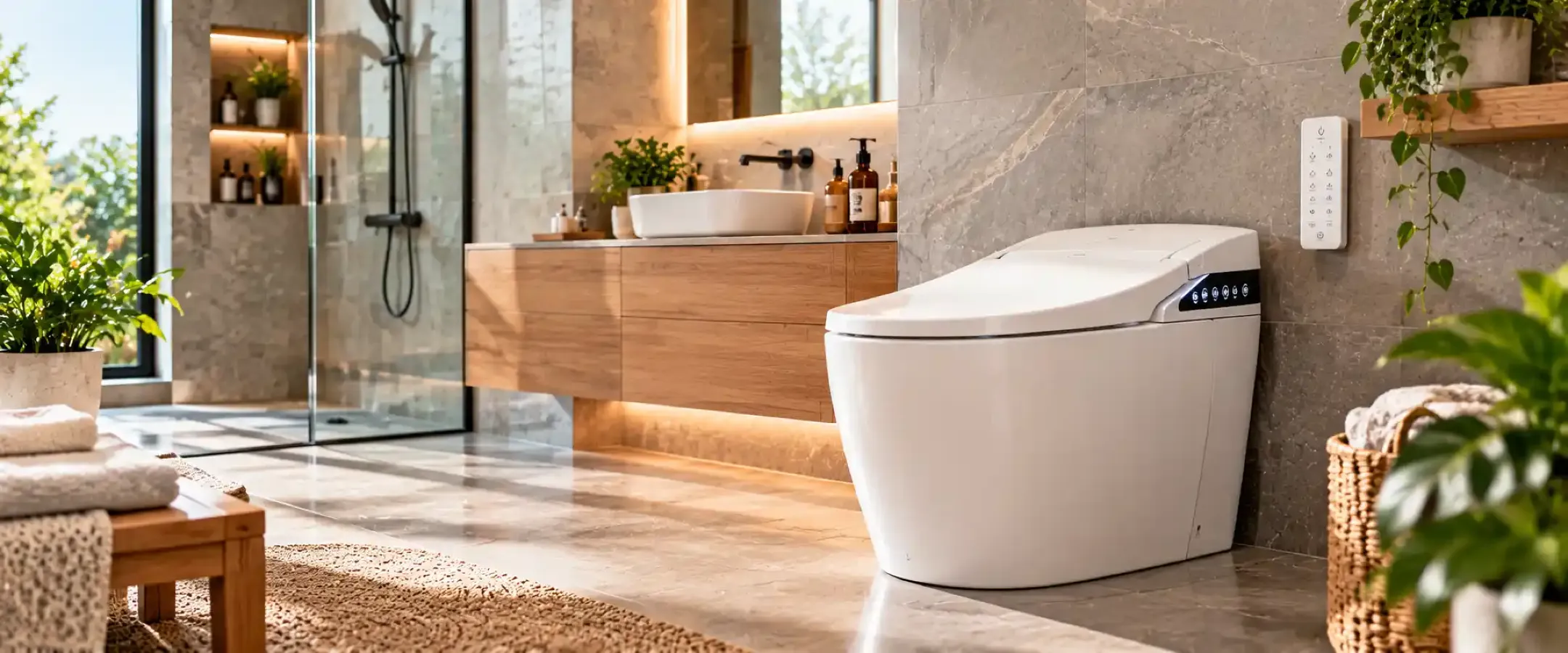
Smart toilets have moved from a novelty to something people genuinely plan a bathroom around. They are also one of the easier things to buy badly, because most of what decides whether one will work in your bathroom has nothing to do with the features list.
Here is what the term actually covers, and the handful of things worth checking before you commit.
What "smart" usually means
There is no single standard, but most smart toilets and smart seats offer some combination of a washing function with adjustable position and pressure, warm air drying, a heated seat, a soft-closing lid, a deodorising filter, and a night light. Better models add a self-cleaning nozzle and a remote or app control.
Not all of it is equally useful. The heated seat and the washing function are the two most people end up using daily. Air drying divides opinion. The night light is a small thing that turns out to matter more than you would expect.
The practical checks, in order of how often they catch people out
Power. A smart toilet needs a power point. Australian bathrooms have strict rules about where a GPO can sit relative to a shower or bath, and many older bathrooms have no outlet near the pan at all. Adding one is an electrician's job and it should be in the plan from the start, not discovered on installation day.
Set-out and trap. Australian pans are typically S-trap (waste through the floor) or P-trap (waste through the wall), and the set-out — the distance from the finished wall to the centre of the waste — has to match. Getting this wrong is the single most expensive mistake in a bathroom renovation, because the fix is usually plumbing work, not a different toilet.
Water pressure. Washing functions need a reasonable supply. If your bathroom already runs weak, check the minimum pressure the model needs before buying.
Seat or whole unit. A smart seat on an existing pan is far cheaper and far less disruptive than a full integrated unit. If the pan is sound and the shape is standard, a seat gets you most of the benefit for a fraction of the work.
Living with one
Maintenance is lighter than people expect, but it is not nothing. The nozzle needs periodic cleaning even on self-cleaning models, the deodorising filter is a consumable, and anything electronic in a wet room benefits from being wiped dry rather than left to sit.
Avoid bleach-based cleaners on the seat and nozzle — they shorten the life of the plastics and seals considerably. Warm water and a mild cleaner is genuinely all that is needed.
Is it worth it?
For most households the honest answer is that the heated seat and the washing function are the reason to buy, and everything else is a bonus. If those two things appeal, a smart seat on your existing pan is the low-risk way to find out whether you will use it.
Browse our smart toilets and smart toilet seats, and if you are mid-renovation, bring your set-out measurement with you to the Wetherill Park showroom. It is a two-minute check that prevents the most costly mistake on this list.