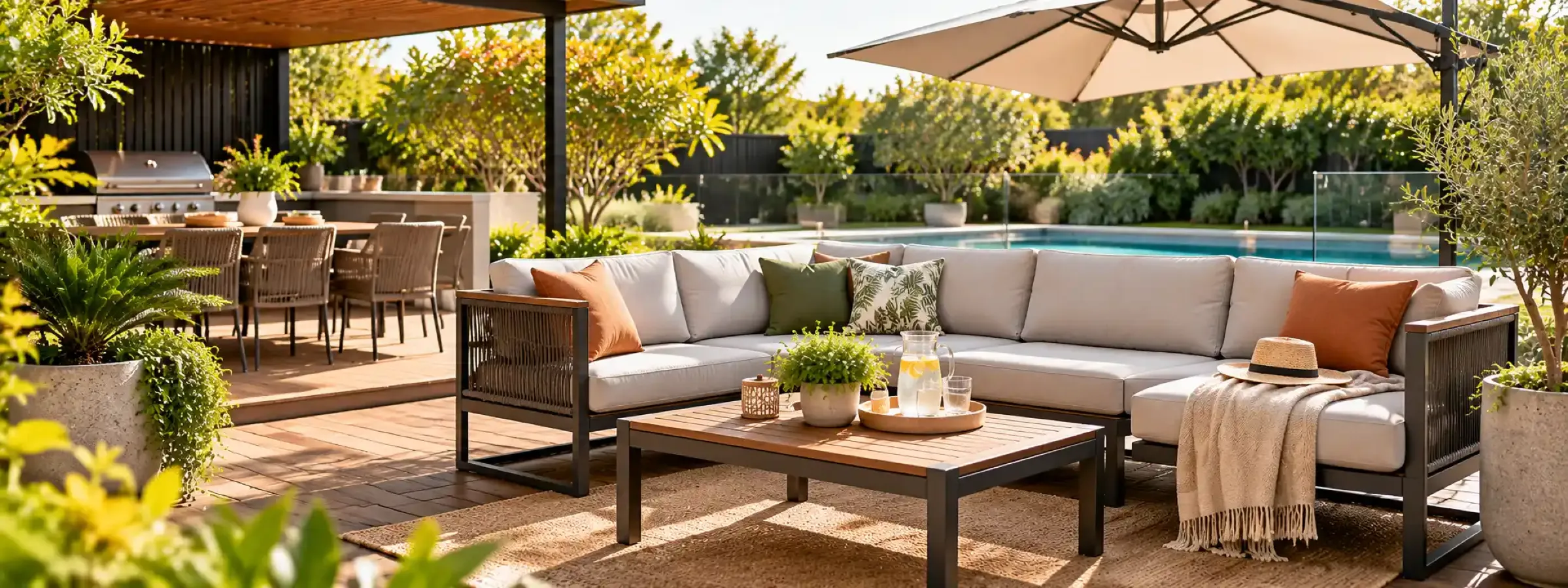
Spring is when the backyard gets looked at properly for the first time in months, and usually when it becomes clear that last season's furniture did not survive as well as hoped. Faded cushions, a rusted joint, a table that wobbles where it did not before.
Outdoor furniture in Australia has a harder life than most people allow for. Here is what actually determines whether a setting lasts a few summers or a decade.
What the climate does
Three things wear outdoor furniture here: ultraviolet light, water, and salt. UV is the relentless one — it fades fabric, chalks paint and makes untreated plastics brittle, and it does this even through light cloud. Rain finds its way into joints and fixings. Near the coast, salt accelerates corrosion on anything that is not properly protected.
A setting that would last twenty years in a sheltered European courtyard can look tired after three summers on an exposed Sydney deck. That is not a quality problem; it is a materials problem.
Choosing the frame
Powder-coated aluminium is the most forgiving option for Australian conditions. It does not rust, it is light enough to move when you want to reconfigure, and a good powder coat handles UV well. It is the safest choice near the coast.
Steel is heavier and more rigid, which suits larger dining settings that stay put and need to resist wind. It must be properly coated, and any chip should be touched up promptly — once moisture reaches the steel, corrosion spreads underneath the coating where you cannot see it.
Resin wicker over an aluminium frame gives the woven look without the maintenance of natural cane. Quality varies enormously: good resin is UV-stabilised through the material, cheap resin is coloured on the surface and goes brittle and pale within a couple of seasons.
Cushions are where settings fail first
The frame usually outlives the soft furnishings by years. Look for solution-dyed fabric, where the colour goes through the fibre rather than sitting on it, and covers that unzip for washing. Quick-dry foam matters more than it sounds — a cushion that holds water after a storm will grow mould long before it wears out.
Even good cushions last longer brought inside or into a storage box during heavy weather and over winter.
Planning the space before buying
Measure, then allow for chairs being pulled out — roughly 750mm behind each seat. The usual mistake is buying a setting sized to the deck rather than to the deck minus circulation space, and ending up with somewhere nobody can walk past comfortably.
Think about shade at the same time. A dining setting in full western sun goes unused from November onwards, whatever it cost. A gazebo or shelter often does more for how much the space gets used than the furniture itself.
A short maintenance routine
Wash frames with warm soapy water a few times a season — particularly near the coast, where rinsing salt off matters more than any polish. Check and tighten fixings at the start of summer. Touch up coating chips when you see them. Store or cover cushions when heavy weather is forecast.
That is genuinely the whole list, and it is the difference between replacing a setting every three years and keeping one for ten.
Have a look at our outdoor furniture and sofa and lounge sets, or visit the Wetherill Park showroom to sit in them — comfort is the one thing a photograph cannot tell you.